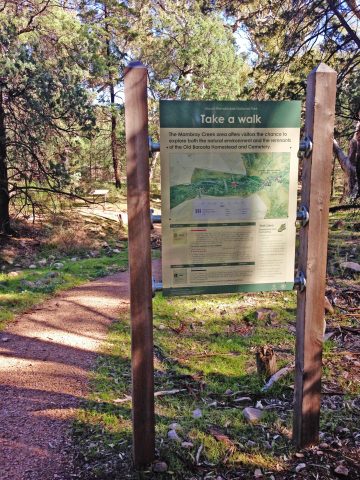
An Accessible Creekside Walk Through the Heart of Mount Remarkable National Park
| Activity | Walking (Grade 1 — Easy) |
| Distance | 1.6 kilometres (loop) |
| Duration | Approximately 30 to 45 minutes |
| Region | Flinders Ranges |
| Accommodation | Bush camping, mid-range and premium options — See accommodation options |
| Start Point | Mambray Creek Campground, Mount Remarkable National Park |
| End Point | Mambray Creek Campground (loop) |
| Accessibility | Gravel surface, mostly accessible for wheelchairs and prams |
| Dogs Allowed | No |
Overview
At the southern gateway to the Flinders Ranges, where the flat agricultural plains of the mid-north give way to the first rough, ancient ridgelines, Mount Remarkable National Park offers some of South Australia’s finest bushwalking. Among its network of trails, the Wirra Water Loop is the most gentle and accessible — a 1.6-kilometre circuit that follows Mambray Creek through a corridor of magnificent river red gums, with interpretive signs that tell the story of water’s central role in shaping this landscape.
This is a walk designed for everyone. The well-maintained gravel surface makes it accessible for wheelchairs, prams, and those with limited mobility, though a few short steeper sections may require some assistance. For families with young children, it serves as a gentle introduction to the national park. For experienced hikers, it makes an ideal warm-up or cool-down walk before or after tackling the park’s more demanding trails.
The Walk
Along the Creek
The loop begins near the Mambray Creek Campground, one of the most popular camping areas in the Flinders Ranges. From the trailhead, the path follows the creek westward beneath a canopy of river red gums — massive, twisted trees with smooth white and grey bark that glow pale gold in the morning light. These ancient trees are the lifeblood of the creek system, their roots binding the sandy soil together and their hollows providing nesting habitat for parrots, owls, and bats.
Interpretive signs along the trail explain the critical importance of water in this semi-arid landscape. Mambray Creek is one of the few permanent water sources in the area, and its presence supports a disproportionate amount of wildlife relative to the surrounding dry country. The signs describe how the red gums draw water from deep underground, how the creek system supports a chain of ecological connections, and how Indigenous Australians managed water resources in this country for thousands of years.
Rocky Creek Beds and Wildlife
The trail passes through sections of dry, rocky riverbed where the geological story of the ranges is written in exposed stone. The creek runs intermittently — flowing after winter rains and retreating to scattered pools during drier months. These pools are magnets for wildlife. Western Grey Kangaroos come to drink at dawn and dusk, emus stalk the creek flats with their distinctive high-stepping gait, and if you sit quietly near the water’s edge, you may see a range of woodland birds coming down to bathe and drink.
The birdlife along Mambray Creek is particularly rich. Adelaide Rosellas flash bright red and blue through the canopy, yellow-tailed black cockatoos pass overhead in noisy groups, and smaller species like superb fairy-wrens and red-capped robins work the understory.
Connecting Trails
The Wirra Water Loop connects to several other walks in the Mambray Creek area, making it easy to extend your time in the park. The Mambray Creek Walk incorporates the Wirra Water Loop as its interpretive section, then continues further along the creek. From there, walkers can connect to the Baroota Hike, which visits the atmospheric Baroota Ruins and the Old Baroota Cemetery — remnants of a pastoral settlement dating to the 1870s. The Sugar Gum Lookout Hike offers a more strenuous option with panoramic views across the ranges.
Planning Your Visit
Mount Remarkable National Park is located approximately 45 kilometres north of Port Pirie, accessed from National Highway One via the Mambray Creek turnoff. The Mambray Creek Campground offers powered and unpowered sites, toilets, barbecue facilities, and a small information shelter. A park entry fee applies.
The best time to visit is between April and October, when temperatures are mild and the park’s spectacular wildflowers are in bloom. Summer visits are possible but temperatures can exceed 40°C, making early morning walks essential. Carry water even for this short walk, as the trail is fully exposed in sections.
The Wirra Water Loop is proof that a walk doesn’t need to be long or difficult to be deeply rewarding. In just 30 minutes, it carries you through one of the most important ecological corridors in the southern Flinders Ranges — a place where ancient red gums stand sentinel along a creek that has been sustaining life in this landscape for longer than human memory can reach.
Where to Stay
Planning an overnight trip? See our Flinders Ranges Accommodation Guide for the best places to stay near this trail.