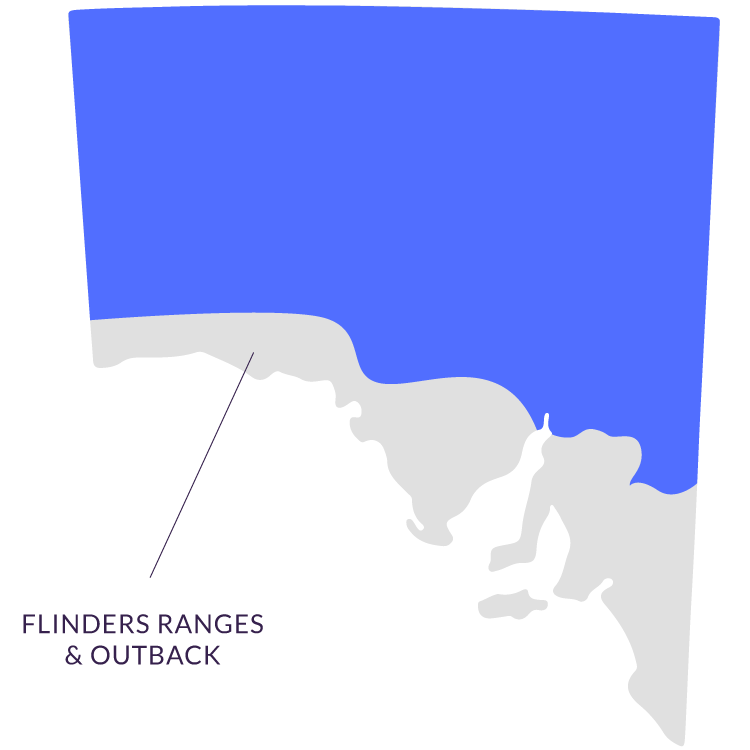
Flinders Ranges & Outback

Ancient Ranges, Desert Landscapes, and the Heart of the Australian Outback

RegionFlinders Ranges & Outback
Trails Available18 trails
ActivitiesWalking
Key AreasFlinders Ranges National Park, Gammon Ranges, Mambray Creek, Mount Remarkable, Alligator Gorge
Distance from Adelaide3–6 hours north
AccommodationBush camping, mid-range and premium options — See accommodation options

Walking Through 800 Million Years of Earth History

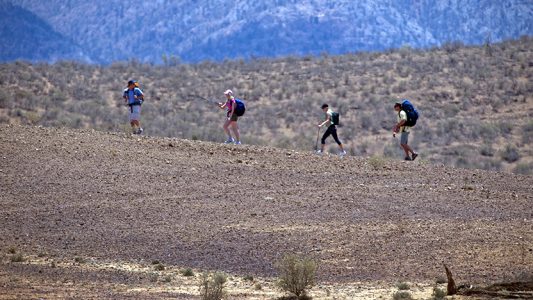
Flinders Ranges & Outback scenery
Photo: DXR / CC BY-SA 4.0 via Wikimedia Commons

The Flinders Ranges are one of Australia’s most ancient and dramatic landscapes — a chain of rugged mountain ranges that stretch for over 430 kilometres from the mid-north of South Australia deep into the outback. These ranges contain some of the oldest geological formations on Earth, with rocks dating back 800 million years or more, preserving the fossil record of the earliest complex life forms to evolve on the planet. The Ediacaran fossils found in these ranges — the oldest known animal fossils — rewrote the story of life on Earth, and the landscape itself is a vast, open textbook of geological time.

For walkers, the Flinders Ranges and the outback beyond offer an experience found nowhere else in southern Australia. The trails here lead through gorges of layered red and ochre rock, across ridgelines with views that stretch to the curve of the Earth, past Aboriginal rock art sites thousands of years old, and through landscapes where the silence is so complete you can hear the wingbeats of wedge-tailed eagles circling overhead. Wilpena Pound — the enormous natural amphitheatre that is the region’s most famous landmark — is just the beginning. The Gammon Ranges, Mount Remarkable, and the gorges of Mambray Creek each offer distinct and rewarding walking experiences.

Mount Remarkable and Mambray Creek

Mount Remarkable National Park, in the southern Flinders Ranges, provides some of the region’s most accessible walking. Alligator Gorge is the park’s dramatic centrepiece — a narrow gorge carved through quartzite rock that you can explore via ring routes and lookout walks. At Mambray Creek, trails lead through native pine forests and up to ridge-top lookouts with sweeping views across the ranges and down to Spencer Gulf. The vegetation here transitions from the dry woodland of the plains to the cooler, moister forests of the ranges, creating ecological diversity that supports a wide variety of birdlife and native animals.

Alligator Gorge Ring Route Hike — Circuit walk through the dramatic quartzite gorge

Ali Lookout Walk — Short walk to views over Alligator Gorge

Sugar Gum Lookout Hike — Mambray Creek — Ridge-top views across the southern Flinders

Daveys Gully Hike — Mambray Creek — Through native pine forest

Wirra Water Loop — Mambray Creek — Gentle loop through creek woodland

The Dutchmans Stern and Quorn

The Dutchmans Stern Conservation Park, near the historic railway town of Quorn, offers one of the most rewarding summit walks in the Flinders Ranges. The trail climbs to the top of the stern — a massive bluff of ancient rock that dominates the skyline — where views open across the ranges in every direction. The valley walk below provides a gentler alternative through woodland and creek beds.

The Dutchmans Stern Hike — Summit walk with panoramic Flinders Ranges views

The Dutchmans Valley Hike — Valley walk through woodland and creek beds

The Dutchmans Valley Hike – Dutchmans Stern CP — Gentler alternative through the valley below the stern

The Dutchmans Stern Hike – Dutchmans Stern CP — The classic summit walk

The Heart of the Flinders — Wilpena and Brachina

Flinders Ranges & Outback scenery
Photo: DXR / CC BY-SA 4.0 via Wikimedia Commons

Wilpena Pound is the Flinders Ranges at their most iconic — an enormous natural amphitheatre formed by a ring of quartzite ridges, visible from space and reached by trails that climb through ancient rock to spectacular lookout points. The Blinman Pools trail follows a creek through a gorge in the central ranges, while the Bunyeroo Gorge Hike takes you through one of the most photographed gorges in Australia, where layers of rock record hundreds of millions of years of geological history.

Blinman Pools Walking Trail — Creek and gorge walk in the central Flinders Ranges

Bunyeroo Gorge Hike — Through one of Australia’s most photographed gorges

Red Hill Lookout Hike — Elevated views across the Flinders Ranges landscape

The Gammon Ranges — Remote Wilderness Walking

The Gammon Ranges, in the northern Flinders, offer the most remote and challenging walking in the region. This is genuine wilderness — rugged, sparsely visited, and demanding in both navigation and physical fitness. The trails here follow creek beds through deep gorges, cross exposed ridgelines, and pass through landscapes where the only other visitors are wedge-tailed eagles and yellow-footed rock-wallabies. The Oppaminda-Nudlamutana Hike is a multi-day trek through some of the most spectacular and isolated country in the ranges.

Balcanoona Creek Hike — Creek walk through the remote Gammon Ranges

McTaggart Track Hike — Extended wilderness walk in the northern Flinders

Monarch Mine Hike — Historic mining heritage in remote ranges

Oppaminda-Nudlamutana Hike — Multi-day wilderness trek — the Gammon Ranges at their wildest

Multi-Region Trails

The Flinders Ranges are the northern terminus of the Heysen Trail — Australia’s longest dedicated walking trail, which stretches 1,200 kilometres from Cape Jervis on the Fleurieu Peninsula to Parachilna Gorge in the Flinders. The Mawson Trail provides a cycling equivalent, connecting Adelaide to the ranges.

Heysen Trail — 1,200 km — Cape Jervis to Parachilna Gorge

Mawson Trail — Long-distance cycling — Adelaide to Flinders Ranges

The Flinders Ranges and Outback offer walking at its most elemental — through landscapes measured in hundreds of millions of years, past the fossil record of life’s earliest experiments, along gorges carved by ancient rivers, and across ridgelines where the view extends to the edge of the outback. These are trails that connect you not just to the land but to deep time itself, and the silence and space of the Australian interior that makes every step feel significant.